Let students practise interpersonal skills, get personalized feedback and coaching, and try again.
Each simulation is playable now and continues to evolve based on student and instructor feedback. Additional assessment and instructor reporting features are in development.
Practice critical reasoning
Debate Quinn, an opponent who mixes strong arguments with flawed reasoning. Can you identify weak arguments, respond effectively, and make a strong case of your own?
Students practice: evaluating arguments, identifying reasoning errors, and responding effectively.
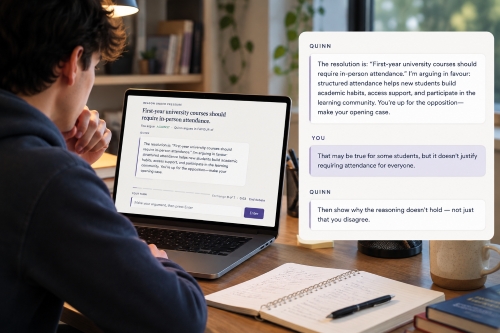
10–20 min · First- and second-year undergraduate · Critical thinking · Communication · Philosophy · Related fields
Features
- Adaptive debate — Quinn responds to the student’s arguments rather than following a fixed script.
- Coach mode — optional support is available during coached runs; independent runs remove the help panel.
- Detailed debrief — see what you caught or missed and how you could have responded more effectively.
- Reasoning assessment — feedback distinguishes genuine reasoning problems from false alarms.
- Try again — students can repeat the debate and apply what they learned.
Practice a job negotiation before its real
Negotiate a multi-issue job offer with Remi, a hiring manager with priorities of their own. Can you uncover what matters to Remi, make effective trade-offs, and create value rather than simply haggle over individual issues?
Students practice: uncovering priorities, responding to offers, managing concessions, making trade-offs, and creating value.
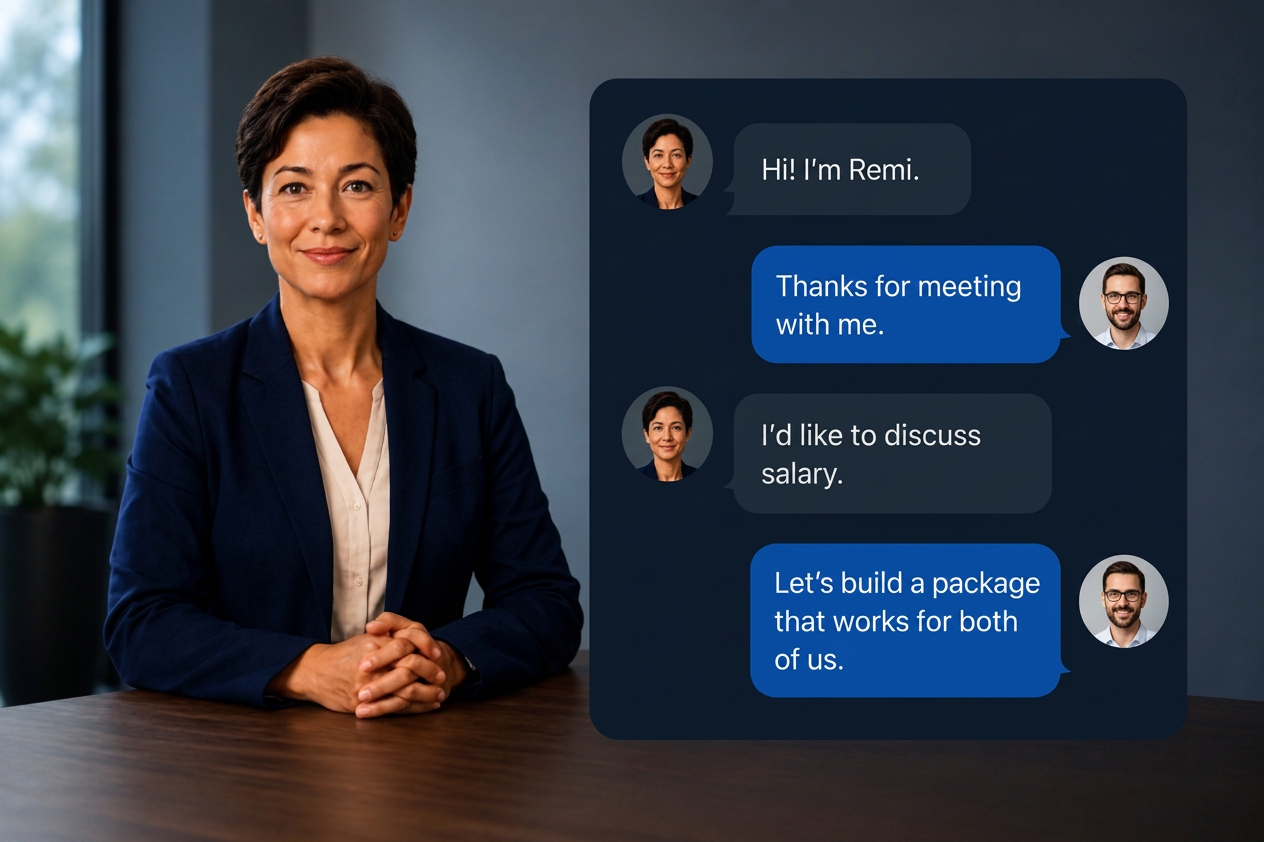
20–30 min · Undergraduate, MBA, professional · Negotiation · Management · Leadership · Career preparation
Features
- Multi-issue negotiation — negotiate salary, bonus, vacation, moving, start date, location, assignment, benefits, and other terms rather than bargaining over a single number.
- Responsive counterpart — Remi responds to the student’s offers, questions, concessions, and negotiation approach.
- Immediate assessment — receive a score, skill ratings, and specific feedback and coaching after each run.
- Individual and joint outcomes — see both the value the student achieved and the total value created.
- Instructor tools — create assignments, review results and transcripts, and export performance data.
- Try again — negotiate again, test a different strategy, and compare results.
Practice respectful influencing
You and your teammate, Jun, disagree on how to proceed with a group project. Can you understand what’s driving Jun’s resistance, make a convincing case, and persuade without pushing too far?
Students practice: listening, diagnosing resistance, adapting arguments, using evidence, and choosing appropriate influence tactics.
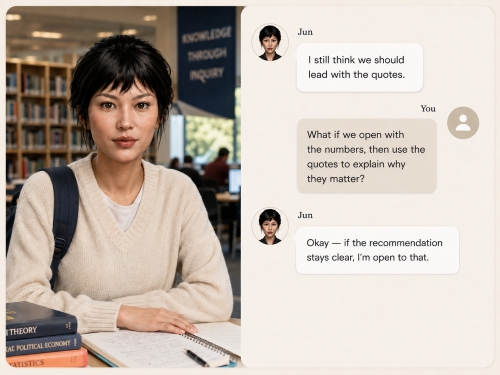
10–20 min · Undergraduate and professional · Organizational behaviour · Leadership · Teamwork · Communication
Features
- A realistic peer, not a pushover — Jun pushes back on vague arguments and weak reasoning.
- Layered concerns — listening and probing can reveal what’s really driving Jun’s resistance.
- Power misuse has a cost — invoking the professor, applying coalition pressure, offering inappropriate inducements, or becoming dismissive can hurt the outcome.
- Specific, actionable feedback — receive ratings across five skill dimensions, explanations for those ratings, and the single change that could have improved the outcome most.
- Try again — repeat the conversation and test a different influence approach.
Practice debate and argumentation (Gr 7–8)
Debate Avery, a friendly AI opponent and coach designed for younger learners. Students choose a topic, build an argument, respond to counterarguments, and receive personalized feedback on how effectively they made their case.
Students practice: structuring debates, making clear arguments, responding to counterarguments, listening to opposing views, and disagreeing respectfully.
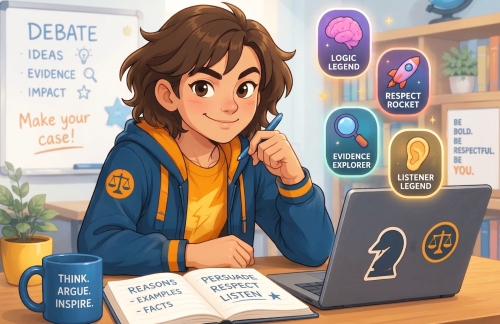
8–12 min · Grades 7–8 · Language Arts · Social Studies · Critical thinking · Debate
Features
- Safe and low-stakes — age-appropriate safeguards keep the emphasis on practice and growth rather than grades.
- Adaptive debate partner — Avery encourages elaboration, challenges reasoning, and responds to the student’s arguments.
- Personalized feedback — students receive feedback based on what they actually said during the debate.
- Badges — students can earn badges such as Logic Legend and Evidence Explorer as they demonstrate key skills.
- Teacher admin panel — create assignments, customize topics, set time limits, and review student activity.
- Try again — students can debate again and apply what they learned.
Interested in using SkillSim with students?
We’re a research initiative, not a commercial software company. If you’re an instructor or researcher interested in using SkillSim, drop us a note and let’s talk.


